

The Peepal Tree
Sacred in our traditions, a quiet companion for reflection, and one of the most giving trees in Indian nature.
One tree, many names
Botanists call it Ficus religiosa. In Marathi it is Pimpal, in Hindi Peepal, in Sanskrit Ashwattha, and across Asia it is honoured as the Bodhi tree. It is a native of the Indian subcontinent and belongs to the fig family, the same family as the banyan.
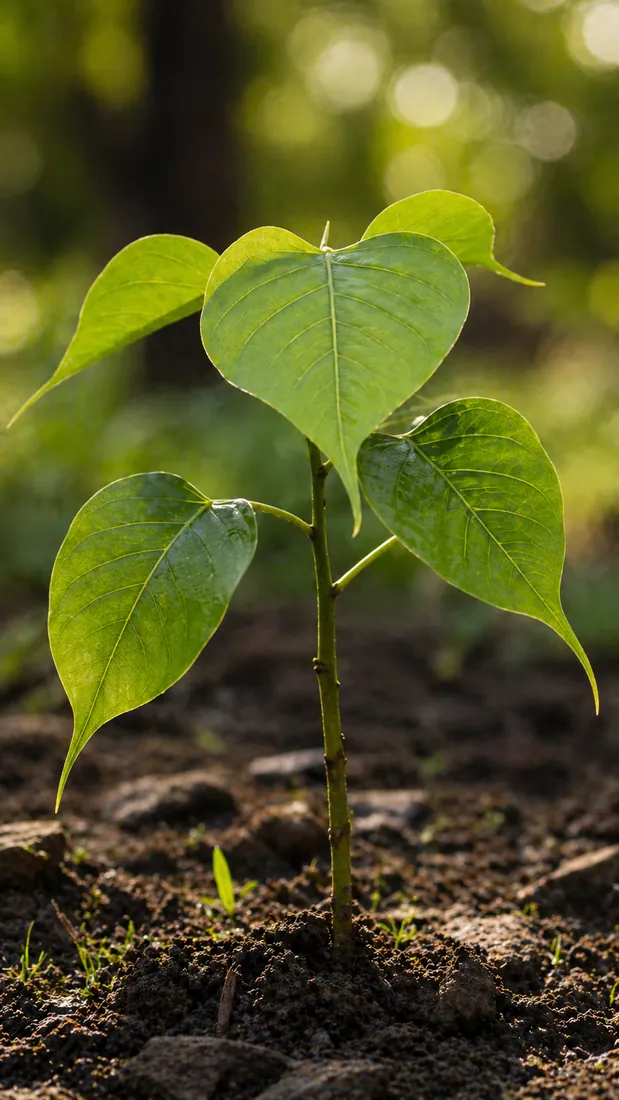
Its heart-shaped leaves end in a long, slender tip that lets rainwater drip away quickly. Because each leaf hangs on a long, flexible stalk, the crown trembles and whispers in even the gentlest breeze — a sound many people remember from childhood temple courtyards.
 Illustrative image
Why the Peepal is held sacred
Few trees carry as much meaning across as many traditions.
In the Bhagavad Gita
In the tenth chapter Shri Krishna names the Ashwattha as his presence among trees, and the fifteenth chapter opens with the image of an eternal Ashwattha whose roots rise upward — a picture of life and the world.
Daily devotion
Devotees pour water at its roots, tie sacred threads, light lamps and walk around it in prayer. In many homes and villages, Saturday worship at the Peepal is a cherished custom.
The Bodhi tree
Gautama Buddha is said to have attained enlightenment while meditating beneath a Peepal at Bodh Gaya. Since then the tree has also been revered in Buddhist lands as a symbol of awakening.
Planting a Peepal is traditionally counted as an act of great Punya — merit that is shared with every living being that rests in its shade.
A natural place for stillness
For centuries, seekers have chosen the shade of a Peepal for prayer, japa and meditation. A broad canopy softens the heat and the light, and the steady rustle of the leaves gives the mind something gentle to rest on.
Many people find that simply sitting with a tree, or watching one grow over the years, brings a sense of patience and connection. Adopting a Punya Peepal is, in that sense, also a small practice of mindfulness: a living reminder that good things grow slowly, with care.
 Illustrative image
What a Peepal does for the land around it
Deep, cooling shade
A grown Peepal spreads a wide crown. Its shade and the moisture its leaves release keep the ground beneath noticeably cooler on hot days — a resting place for people, cattle and birds.
Food for wildlife
Its small figs feed parakeets, barbets, mynas, bulbuls, hornbills, squirrels and fruit bats. Fig trees fruit at different times of year, so they often feed wildlife when little else is available.
A tiny partnership
Every Peepal depends on a tiny wasp that pollinates its hidden flowers, and that wasp can breed nowhere else. Planting a Peepal keeps this remarkable partnership of nature alive.
Healthier soil
Its spreading roots help bind the soil against erosion, and its fallen leaves break down into a natural mulch that feeds the earth.
Cleaner surroundings
Like other large trees, its leaves trap dust from the air, and as it grows it stores carbon in its trunk and branches for a very long time.
A life of centuries
A Peepal can live for hundreds of years. The Sri Maha Bodhi in Sri Lanka, grown from a sapling of the Bodh Gaya tree, is traditionally dated to more than 2,000 years ago.
A note on claims: you may read that the Peepal gives oxygen all night or cures illnesses. Like every tree, the Peepal releases oxygen while it photosynthesises in daylight, and it is not a medicine. We prefer to celebrate its many real gifts rather than repeat claims that are not established science.
 Real photo
Every tree adds to India's green cover
India has set itself the goal of growing its forest and tree cover, and that effort is made of millions of individual trees planted and protected by ordinary people. A native, long-lived tree like the Peepal is one of the most valuable contributions a person can make to that green future.
Punya Peepal-Ayu Prasadam is our small, practical part in it: each adoption means one more native tree planted in Nashik Region and looked after through its most delicate first years.
Punya Peepal-Ayu Prasadam is an independent initiative of Trimbakeshwar NEST and is not part of any government scheme.
The tree at the heart of the village
Think of the stone platform around an old Pimpal — the pimpalacha paar — where elders gather in the evening, travellers rest, children play and village decisions are made. For generations the Peepal has been a meeting place as much as a place of worship.
Why we plant with care
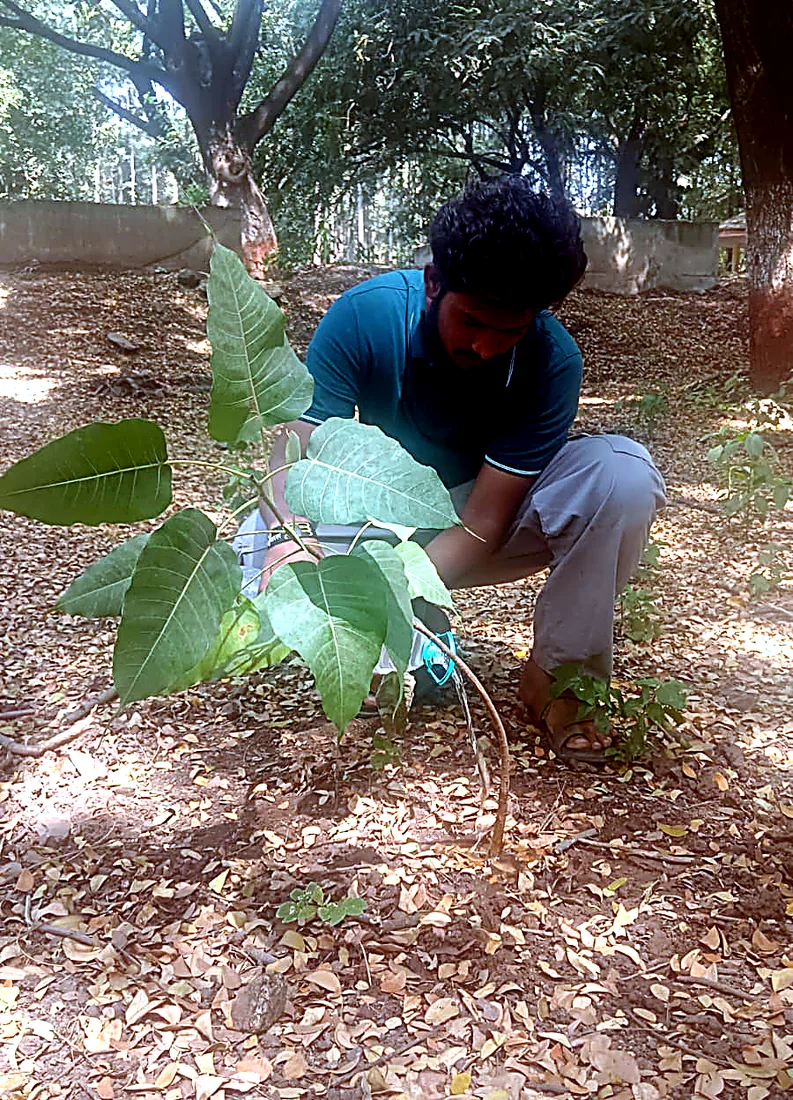
A Peepal grows into a very large tree with strong roots, so it needs open ground away from walls, buildings and pipelines. That is why our team plants only in suitable open land, with the permission of the landowner, and stays with each sapling through its first years.
How we care for each tree Illustrative image